Modern Slavery Reporting Requirements
In Australia, the Modern Slavery Act 2018 commenced operation on 1 January 2019, creating reporting obligations for certain entities. The term modern slavery is used to describe situations where coercion, threats or deception are used to exploit victims and undermine or deprive them of their freedom. It describes serious exploitation and not substandard working conditions or the underpayment of workers. The Australian government, in support of UN Guiding Principles, aims to combat modern slavery in the Australian community and in the global supply chains of Australian goods and services.
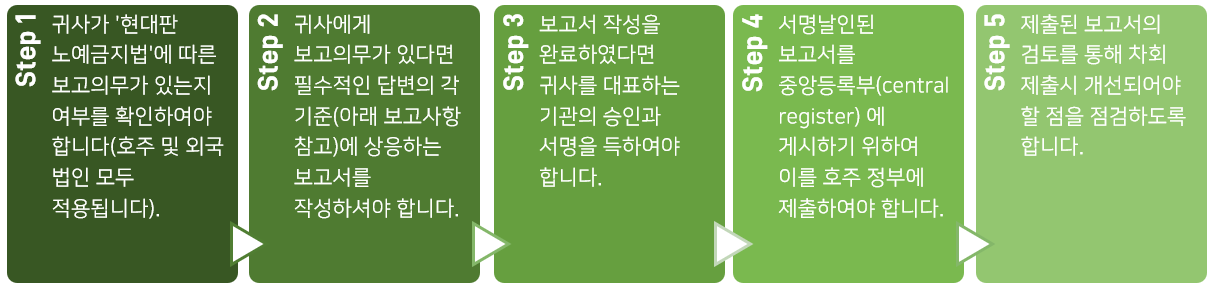
Who needs to report?
Entities that have:
- Consolidated revenue of at least $100 million for the relevant reporting period (a financial year), and which
- Are Australian identities, or
- Undertake business in Australia in that financial year
What do I need to report?
The mandatory criterion are:
- The reporting entity’s structure, operations and supply chains;
- Modern slavery risks in the reporting entity’s operations and supply chains (including those of subsidiary entities);
- Actions taken (including by subsidiary entities) to assess and address those modern slavery risks, including due diligence and remediation processes;
- How the reporting entity assesses the effectiveness of actions taken; and
- The process of consultation with subsidiary entities in preparing the modern slavery statement.
When do I need to report by?
Affected entities must report in respect of the first full reporting period following commencement and must report within 6 months of that period ending. For example, the reporting period for entities with a 30 June year end will be 1 July 2021 to 30 June 2022, with reporting due by 31 December 2022.
Further information
Further information and links to the online registers can be found here: https://www.homeaffairs.gov.au/criminal-justice/Pages/modern-slavery.aspx
Please contact H & H Lawyers for further legal advice for submitting a modern slavery report.
Key Contacts

洪敬一
管理合伙人

金震汉
合伙人
Related Insights
查看更多工作场所与雇佣,雇佣合同/顾问协议,限制从业的执行,工作场所健康与安全的合规,商业&公司法务
2026年8月19日
Working from Home in Victoria: Commencement Delayed to July 2027
On 28 July 2026, Ben Carroll was sworn in as the 50th Premier of Victoria, following the resignation of Jacinta Allan, who had championed the work from home policy. Within days, and after meeting business groups, the new Premier confirmed that the Government would consider "sensible changes" to the Bill as it moves through Parliament. A Victorian State election follows on 28 November 2026.
工作场所和劳资纠纷,雇佣合同/顾问协议,限制从业的执行
2026年5月29日
Modern Slavery Reporting Requirements For Australian Subsidiaries and Foreign Entities in Australia
As we approach mid-year, many Australian subsidiaries of multinational corporations and foreign entities registered in Australia should be preparing their modern slavery statements. This article examines the reporting obligations under Australian laws, including the critical issue of revenue consolidation that often catches foreign-owned entities by surprise. The Reporting Obligation Australia’s Modern Slavery Act 2018 (Cth) (the “Act”) requires entities to submit annual modern slavery statements if they meet the revenue threshold.
雇佣合同/顾问协议
2023年1月9日
Key changes to Australian employment law
On 6 December 2022, the Fair Work Legislation Amendment (Secure Jobs Better Pay) Act 2022 received Royal Assent, amending the Fair Work Act 2009 (Cth). The key amendments to the Fair Work Act are as follows: 1. Casual Conversion – currently in effect 2.
工作场所和劳资纠纷,雇佣合同/顾问协议,限制从业的执行
2022年4月4日
High Court Clarifies Definition of Casual Employee
As one of the most significant decisions by the High Court in 2021, the High Court has determined the meaning of a casual employee in Workpac Pty Ltd v Rossato [2021] HCA 23. Mr Rossato was employed as a production worker by Workpac’s labour-hire company under a series of six contracts, or assignments, to perform work for one of Workpac’s clients. While Mr Rossato was required to work regular and full-time hours according to a fixed pattern of work, Workpac treated Mr Rossato as a casual employee, such that Mr Rossato was not paid the leave or public holiday entitlements under the Fair Work Act 2009 (Cth) (the Act) and the enterprise agreement. The Court confirmed that the question of whether a person is a casual employee is to be determined by considering the express terms of a written employment contract, and not on the basis of any subsequent conduct of either party. To this extent, the court held any such commitment to further work must be contained in an enforceable agreement to be recognised. The High Court held that a casual employee is an employee who has no “firm advance commitment as to the duration of the employee’s employment or the days (or hours) the employee will work” and provides no reciprocal commitment to the employer.
雇佣合同/顾问协议
2020年6月24日
临时工 vs 正式工
2020年5月20日,澳大利亚联邦法院全席法庭对WorkPac Pty Ltd v Rossato一案作出判决。 此案聚焦并围绕劳务派遣公司WorkPac Pty Ltd(以下简称 “WorkPac”)和Robert Rossato (以下简称“Rossato”)之间的雇佣关系进行展开。该公司派遣Rossato先生到Glencore公司名下两处位于昆士兰州的矿山工作。Rossato先生作为临时员工 (casual employee)工作的三年半期间,签订的是滚动合同(rolling contract)。作为一名临时员工,他在工资的基础上还获得了25%的额外报酬 - 这是为了弥补临时员工未能享有类似年假等福利的通常做法。 澳大利亚联邦法院全席法庭驳回 WorkPac 认为Rossato先生是临时员工的主张,判定他属于正式员工(permanent employee)。联邦法院基于以下理据,做出上述判决:Rossato先生的工作性质是 “定期(regular)、稳定(certain)、连续(continuing)、持续性(constant)” ,而且有事先被告知工作日程。 Rossato先生有资格享受根据《2009年公平工作法》(Fair Work Act 2009 Cth)和企业协议(Enterprise Agreement)中全国就业标准(National Employment Standards - NES)所规定正式员工应享有的福利,其中包括带薪年假,个人病假/照顾者假,丧病假及法定公共假日等。 这一判决对于雇佣临时员工的雇主,无论是通过直接雇用、外包劳务、转包等不同的雇佣途径,都是不能忽视的重要判决。对于该判决,联邦政府可能会采取干预措施或向最高法院提出上诉,但是在判决发生改变之前,雇主现在应该仔细审查与临时员工之间的雇佣安排,更新与临时员工的合同条款。雇主应重新考量与劳务派遣公司以及派遣员工之间的关系,特别需要注意以下三点: 如果您认为WorkPac Pty Ltd v Rossato的判决结果,会对您公司现有员工的工作安排有所影响,或者在处理与员工之间的雇佣关系上需要专业的法律意见,请与我们联络。
雇佣合同/顾问协议
2018年8月1日
Are You At Risk of Sham Contracting?
Online food delivery competitor Foodora has been accused of sham contracting its own employees and now faces legal action launched by Australia’s Fair Work Ombudsman. As business opportunities increase in Australia more employers turn to flexible and intuitive ways to cut costs and maximise profits, which can sometimes lead to cutting corners and the underpayment of employees. It is important for an employer to enter into valid employment contracts with its employees, as it will assist them in avoiding the risk of being accused of sham contracting. What is Sham Contracting? Sham contracting is an illegal method of employment under section 357 of the Fair Work Act 2009 (Cth), where the employer misrepresents the employee as an independent contractor. Any employer that makes such misrepresentation of the employment relationship is liable for penalties under that Act.